|
By William Weathersby, Jr.
 |
Architect:
Carney Architects
Builder:
Epstein Lovett Construction

Landscape designer:
Design Workshop |
| |
|
Most couples contemplating their prospective dream home compose wish lists
of their favorite architectural details and lifestyle amenities. Few, however, are likely to map out a building game plan
as comprehensive as the document drafted by Carol and John Harkness. When they met with architect Kevin Burke to discuss building their retirement home
in Teton Village, Wyoming, they arrived with a six-page (single-spaced) project “brief” detailing precise requirements for the house. And these weren’t even notes about the usual aesthetic concerns regarding fixtures and finishes; their highly detailed punch list explored everything from passive solar heating to the specifications of handicapped-accessible elevators and doorways.
“I’ve never had clients as passionate about every design detail of their new house,” says Burke, associate architect at Carney Architects in Jackson, Wyoming. “The Harknesses were involved with every design and construction decision along the way, from where best to site the house to selecting the grade of insulation between each wall.”
“This was planned as the last house we would build as we entered the retirement phase of our life,” says Carol. “John and I had been thinking about exactly what we wanted for more than a decade, so I guess the attention to every element showed.”
Admittedly, John and Carol both have technical backgrounds that would trump the curiosity about construction many custom-home clients might possess. He worked as a chemical engineer at the prestigious Argonne National Laboratory; she was a computer software developer. In addition, John had previously outfitted their home in a Chicago suburb with passive solar features. Now that they were retiring to Wyoming, the couple sought even more energy efficiency and adaptability within the home they were building on a half-acre lot at the base of the Jackson Hole Mountain Resort.
“We’re not too hung up on aesthetics,” says John, “but the practicality and future performance of the house were important to us.” One of the couple’s goals was to make the house thoroughly handicapped accessible, particularly because John has a brother with muscular dystrophy. They also agreed it should be heated and cooled with active and passive systems to the greatest degree possible, for both energy conservation and long-term financial benefits.
The 4,300-square-foot house sits on a steeply sloping meadow near the base of the resort. Avid skiers and climbers, John and Carol selected a lot that would allow them to easily walk to the slopes and to a nearby music festival.
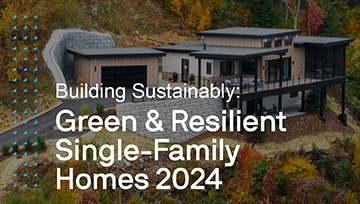
Despite the Harknesses’ list of mandates for the house, ironically, its architectural design was also influenced by restrictions set by the previous owner of the property. “He was moving across the street and didn’t want our new house to block his view,” Carol recalls. The height and siting restrictions “actually inspired our creativity,” Kevin Burke says. Clad in cedar siding with copper bump-outs, the house has a sloping metal roof that does not obstruct the neighbor’s views of the mountains. A wall of windows on the back side of the house opens to views of the valley.
The Harknesses planned the house to easily accommodate changes in lifestyle they may face as they age. With Burke, the couple plotted the three-level house in zones, with a self-contained main floor serving most of their day-to-day needs, encompassing a bedroom, living and dining area, bathroom, and kitchen. A suite on the upper floor, which can be reached by an elevator, features the most accessibility fittings for physically challenged occupants, including hand railings in a bathroom and wide doorways. The lowest level features another bedroom, study, workshop, and two bathrooms.
Technically, the house is more efficient and eco-friendly than any Burke can recall building, he says. Many of the building materials were selected for their environmental sensitivity and sustainability, such as interior flooring made from cork, a renewable resource. The outdoor decking is made from recycled plastic.
The “super-insulated” envelope of the building goes far beyond typical standards for houses in the region. An air-to-air heat exchanger introduces fresh air using warm air from the house to preheat the cool outside air as it enters. “The house is very tight, and we can keep our thermostats set to 55 degrees,” John says.
Outfitted with extensive technical features, yet conveying warmth and coziness with a generous use of natural materials, the Harkness house makes a strong case for homeowners taking charge of their “domestic engineering.”
|